US Escalates Tech War: 15% Tariff Slapped on Critical Chip Material to Safeguard Domestic Industry
The United States has imposed a 15% tariff on a vital chip material, signaling a significant escalation in its strategic competition with China over semiconductor dominance. This move aims to fortify American firms against burgeoning Chinese competition.
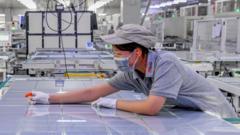
Source image: bbc.com
bbc.comUS Imposes 15% Tariff on Key Chip Material Amid Intensifying Tech Rivalry with China
In a significant escalation of the ongoing technological and economic rivalry with China, the United States has announced a 15% tariff on a critical chip material. This strategic move, spearheaded by the Trump administration, is designed to fortify the domestic semiconductor industry and protect American firms from what it perceives as unfair competition and aggressive expansion by Chinese technology companies.
The semiconductor industry is not merely a sector of the economy; it is the foundational bedrock of modern technology, underpinning everything from artificial intelligence and advanced computing to telecommunications and defense systems. The ability to design, manufacture, and control the supply chain for these vital components is increasingly viewed as a matter of national security and economic sovereignty. Therefore, the imposition of a tariff on a key material used in chip production is far more than a simple trade adjustment; it is a declaration of intent in a high-stakes geopolitical contest.
Why This Tariff Matters: Protecting Domestic Innovation and Supply Chain Resilience
The primary rationale behind this tariff is to safeguard American innovation and ensure the long-term viability of its semiconductor industry. US officials have repeatedly voiced concerns about China's ambitious industrial policies, which include massive state subsidies and alleged intellectual property theft, giving Chinese firms an unfair advantage in the global market. By increasing the cost of a crucial input for Chinese manufacturers, the US aims to level the playing field and encourage domestic production and sourcing.
Furthermore, this action speaks to a broader strategy of supply chain de-risking. The COVID-19 pandemic and subsequent geopolitical tensions have exposed vulnerabilities in global supply chains, particularly the over-reliance on single geographic regions for critical components. By making it more expensive for Chinese firms to access key materials, the US hopes to incentivize diversification and reshoring of manufacturing capabilities, thereby enhancing its own economic resilience and reducing its dependence on potential adversaries.
Market Implications: Costs, Retaliation, and Strategic Shifts
The immediate market implications of this tariff are multifaceted. Firstly, companies globally that rely on this specific chip material, particularly those with manufacturing operations in China, are likely to face increased production costs. These costs could either be absorbed, impacting profit margins, or passed on to consumers, potentially leading to higher prices for a wide array of electronic goods.
Secondly, the potential for retaliatory measures from Beijing is a significant concern. China possesses its own set of economic levers and could respond with tariffs on US exports or restrictions on the export of rare earth minerals, which are vital for many high-tech industries and where China holds a dominant position. Such a tit-for-tat escalation could further destabilize global trade relations and create an even more fragmented international economic landscape.
Finally, this tariff is expected to accelerate the ongoing strategic decoupling between the US and Chinese technology ecosystems. Companies may be compelled to re-evaluate their global manufacturing footprints, invest in new production facilities outside of China, and seek alternative suppliers for critical materials. This could lead to a more bifurcated global technology market, with distinct supply chains and standards emerging in different geopolitical blocs.
What Investors Should Watch: Navigating a Fracturing Global Economy
For investors, this development necessitates a careful re-evaluation of portfolios and investment strategies. Key areas to watch include:
- Supply Chain Resilience: Companies with diversified supply chains and robust contingency plans will be better positioned to weather potential disruptions.
- Geopolitical Risk Exposure: Assess the exposure of investments to countries and sectors at the forefront of US-China tensions.
- Innovation and Domestic Production: Look for companies that are investing in domestic research and development and manufacturing capabilities, as these may benefit from government incentives and protectionist policies.
- Commodity Markets: Monitor the prices and availability of critical raw materials, as tariffs and trade disputes can significantly impact these markets.
- Policy Developments: Stay abreast of evolving trade policies and geopolitical developments, as these will continue to shape the investment landscape.
The imposition of this tariff underscores a new era of strategic competition, where economic policy is increasingly intertwined with national security objectives. Executives, investors, and entrepreneurs must adapt to this evolving landscape, prioritizing resilience, strategic foresight, and a deep understanding of geopolitical dynamics to navigate the challenges and opportunities that lie ahead.
Continue reading
Related coverage in Business
nytimes.com
David Ellison Targets CNN Leadership Continuity in Paramount Merger Talks
David Ellison is currently negotiating to retain CNN CEO Mark Thompson without oversight from CBS editor in chief Bari Weiss as parent companies navigate merger plans.
2 min read
bbc.com
Decoding Nike’s Slump: How Strategic Missteps Cost the Sportswear Titan Its Edge
Explore the factors behind Nike's dramatic market decline. Industry analysts dissect the self-inflicted strategic errors that shook the sportswear giant.
3 min read
bbc.com
Treasury Committee Directs HMRC to Investigate Tax Implications of Manchester City Case
The UK Treasury Committee has called on HMRC to closely examine potential tax ramifications arising from the high-profile Manchester City legal verdict.
3 min read
nytimes.com
US Imposes Sanctions on Russian Firm A7 Over Global Shell Company Evasion Schemes
The United States targets Russian financial firm A7 with new sanctions following reports of utilizing global shell companies to bypass existing economic restrictions.
3 min read