Quantum Countdown: IonQ Unveils Superion 256 and Stirs Crypto Security Debates
IonQ's new Superion 256 and aggressive scaling roadmap accelerate quantum threats to Bitcoin's encryption, triggering urgent debates across digital asset markets.
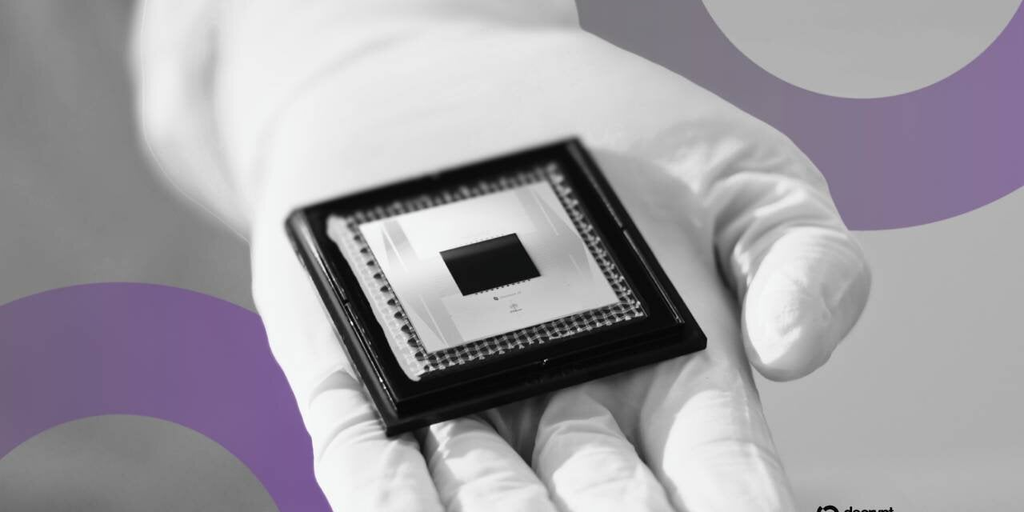
Source image: decrypt.co
decrypt.coThe Quantum Milestone Meets the Blockchain Frontier
The intersection of advanced quantum computing and decentralized digital assets has officially entered a high-stakes phase. IonQ, a prominent name in full-stack quantum platforms, has formally introduced its Superion 256 system alongside a vertically integrated manufacturing roadmap enabled by its recent acquisition of SkyWater Technology. However, while enterprise markets focus on the hardware delivery timelines slated for 2027, the broader financial ecosystem is zeroing in on the profound implications these developments hold for cryptographic security.
During recent high-profile briefings, IonQ leadership underscored a shifting timeline for what the industry terms 'Q-Day'—the theoretical threshold when fault-tolerant quantum computers will possess the computational muscle to break foundational public-key cryptography. By publishing detailed resource estimates for running Shor's algorithm against the 256-bit elliptic curve standard (secp256k1) utilized by Bitcoin, the discourse has decisively pivoted from abstract theoretical risk to concrete engineering milestones.
An Engineering Blueprint for Cryptographic Vulnerability
At the heart of the recent market anxiety is a granular technical paper released by IonQ's research division. Rather than relying on high-level macro projections, the team mapped out a complete, end-to-end fault-tolerant resource estimate down to individual error-correction primitives.
- Physical Qubit Requirements: The model concludes that approximately 19,397 physical qubits integrated within a fault-tolerant architecture could execute an attack on a Bitcoin-style signature scheme.
- Time-to-Crack Metrics: Under optimal operational parameters, a single modeled attempt is estimated to take roughly 25.7 days to resolve the discrete logarithm problem.
- Roadmap Alignment: IonQ's internal schedule targets a 10,000-physical-qubit system by 2027, scaling directly toward the 20,000-qubit threshold around 2028.
Although these machines remain under development and present monumental engineering hurdles—including maintaining coherence and scaling error correction—the timeline compression has caught institutional investors off guard. What was once casually dismissed as a late-21st-century challenge is increasingly viewed as a mid-term strategic variable.
Market Implications and Corporate Resilience
The friction between rapid quantum advancement and cryptocurrency longevity introduces complex dynamics for institutional capital allocators. Intriguingly, major corporate holders of Bitcoin have largely maintained or expanded their crypto treasuries despite the shifting horizon, signaling confidence in the network's capacity to upgrade its core cryptographic protocols well before commercial quantum threats materialize.
Furthermore, IonQ's dual positioning as both an advanced quantum systems manufacturer and a provider of security solutions highlights a lucrative commercial irony. As enterprises race to future-proof their digital infrastructures against quantum decryption, demand for post-quantum cryptography (PQC) and hardened network architecture is surging. This environment has allowed firms like IonQ to secure lucrative enterprise contracts even as they sound the alarm on legacy vulnerabilities.
What Investors and Executives Should Watch
For stakeholders navigating the convergence of quantum tech and digital assets, several key indicators will dictate market sentiment over the next 24 to 36 months:
- NIST PQC Migration Pace: Monitor how rapidly financial institutions and blockchain core developers adopt National Institute of Standards and Technology post-quantum cryptographic standards.
- Superion Scale Execution: Track IonQ's ability to transition from the Superion 256 prototype to high-volume semiconductor fabrication via its SkyWater foundry integration.
- On-Chain Upgrade Readiness: Evaluate developer consensus within the Bitcoin community regarding soft or hard fork proposals designed to implement quantum-resistant signature schemes ahead of schedule.
Ultimately, while an imminent quantum breach of major digital assets remains constrained by hardware limitations, the acceleration of engineering roadmaps ensures that cryptographic migration will transition from a passive background task to an urgent executive priority.
Continue reading
Related coverage in Crypto
cointelegraph.com
Trump Schedules Third Memecoin Holder Dinner Amid Growing Corruption Scrutiny
President Trump is set to host his third exclusive memecoin dinner for top token holders at his Washington, DC golf club, drawing renewed ethical and market scrutiny.
3 min read
cointelegraph.com
50,000 Europeans Petition EU to Relax MiCA Stablecoin Reward Restrictions
A new 50,000-letter campaign is urging Brussels to ease stablecoin rewards restrictions during the MiCA review, aligning with broader central bank pushes.
2 min read
cryptonews.com
Dogecoin Eyes $1 Milestone as DogeOS Testnet Launch Sparks Utility Speculation
Dogecoin trades at $0.09447 as the DogeOS testnet goes live. Traders eye the $0.098 resistance and psychological $0.10 mark amid fresh utility potential.
2 min read
decrypt.co
Bitcoin Enters 'Uptober' Amid Fed Rate Hike Pressures and 5.3% Treasury Yields
Bitcoin enters its historically strongest month following a record September, yet rising Federal Reserve rate hike fears and 5.3% Treasury yields present major hurdles.
2 min read