AssetMark CEO Michael Kim Discusses Advisor Growth and Capacity at WealthManagement.com
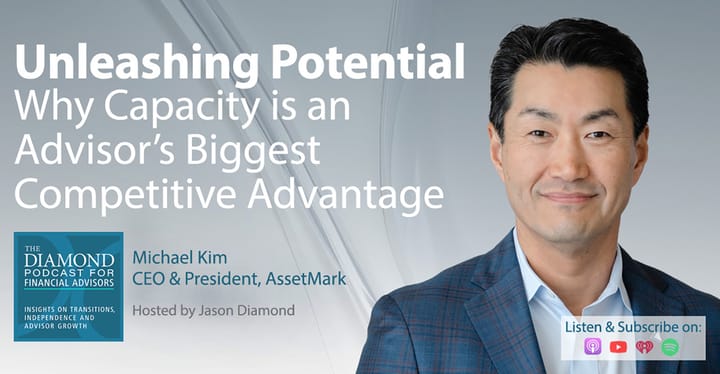
AssetMark CEO Michael Kim shares insights on WealthManagement.com about how financial advisors can build a competitive advantage by leveraging capacity, technology, and AI.
Source image: wealthmanagement.com
wealthmanagement.comUnlocking Growth Through Strategic Capacity
In the latest episode of The Diamond Podcast for Financial Advisors, AssetMark CEO Michael Kim highlighted a transformative shift in the wealth management sector. According to Kim, an advisor's primary growth constraint is no longer client acquisition alone, but rather operational capacity. As client expectations evolve and regulatory complexities mount, traditional practice management models are reaching their limits. Firms that successfully unlock capacity are positioning themselves to capture outsized market share.
The Core Drivers: Outsourcing, Technology, and AI
To overcome operational hurdles, Kim pointed to three critical levers that modern financial advisors must pull:
- Strategic Outsourcing: Delegating non-core functions such as back-office administration, portfolio management, and compliance allows internal teams to focus on core competencies.
- Advanced Technology: Implementing integrated platforms streamlines workflows, reduces manual errors, and provides a unified view of client portfolios.
- Artificial Intelligence: Leveraging AI tools automates repetitive tasks, uncovers data-driven client insights, and optimizes day-to-day decision-making processes.
By integrating these solutions, practices can effectively multiply their output without linearly increasing headcount, thereby improving profit margins and scalability.
Market Implications for Wealth Management Executives
The strategic emphasis on capacity has wide-ranging implications for the broader wealth management industry. Enterprise leadership and independent firm owners are increasingly evaluating technology stacks not just for cost-efficiency, but for their ability to free up human capital. Advisors who spend less time on routine paperwork can dedicate more energy to complex financial planning, behavioral coaching, and deep relationship management—areas where human expertise is irreplaceable and commands the highest value.
Furthermore, as consolidation continues across the independent advisor space, enterprise platforms that offer robust outsourcing solutions and cutting-edge AI integrations will likely attract top-tier talent and fast-growing practices.
What Investors and Entrepreneurs Should Watch
Industry stakeholders should monitor several key trends moving forward:
- The adoption rate of generative AI and automated workflow tools among independent RIAs and broker-dealers.
- The growth of turnkey asset management programs (TAMPs) and specialized third-party service providers offering comprehensive outsourcing.
- Shifts in client retention metrics as top-performing advisors transition more time toward high-touch strategic advisory services.
As competition intensifies, the ability to engineer operational capacity will separate stagnant practices from market leaders. For more details, read the original report on WealthManagement.com.
Continue reading
Related coverage in Banking
wealthmanagement.com
Orion Ascent 2027 Conference Announced: Focusing on AI and Household-Level Wealth Personalization
Orion has opened registration for Ascent 2027 in Orlando, focusing on practical AI workflows, household-level personalization, and scaling advisory capacity.
3 min read
wealthmanagement.com
Wealth Management CIOs Pivot to Short-Duration Bonds Amid Market Shudders
Rising bond yields are transforming fixed-income strategies, allowing wealth management chief investment officers to capture attractive yields at shorter durations with lower risk.
2 min read
wealthmanagement.com
IRS Guidance Prompts Compliance Experts to Warn RIAs Over Section 351 ETF Conversions
Compliance experts warn registered investment advisors to reconsider Section 351 ETF conversions for tax purposes following recent IRS guidance targeting tax avoidance.
3 min read
wealthmanagement.com
Fidelity Raises RIA Custody Minimum to $100M, Pressuring Smaller Advisory Firms
Fidelity Investments is raising its RIA custody asset minimum to $100 million, requiring existing advisors below the threshold to exit or transition off the platform by June 30, 2027.
3 min read